InboxPilot vs Shortwave: Email Automation Platform Comparison
January 23rd, 2025 • 10 min read
Last updated: January 24th, 2026
InboxPilot vs Shortwave: Email Automation Platform Comparison
Shortwave positions itself as an AI-powered email client with features like Ghostwriter and natural language search. However, at $24-100 per seat per month, the platform's cost structure and requirement to switch email clients create barriers for businesses seeking email automation.
InboxPilot takes a different approach, integrating with existing email platforms rather than replacing them. This comparison examines how each platform addresses business email automation needs, implementation requirements, and total cost of ownership.
Platform Comparison Overview
| Feature | InboxPilot | Shortwave |
|---|---|---|
| Starting Price | $0/month (Free plan) | $24/month per seat (Business) |
| Pricing Model | Usage-based, unlimited seats | Per-seat pricing |
| Email Automation | Draft or auto-send with rules | Draft only (Ghostwriter) |
| Email Actions | Unlimited automation workflows | Not available |
| Custom Knowledge Base | Website, docs, CRM, past emails | Limited to email history |
| Customization | Full control (tone, length, workflows) | Limited AI customization |
| Works with Existing Email | Yes (Gmail, Outlook) | No (requires new email client) |
| Free Tier | 15 emails/month, unlimited actions | 14-day trial only |
| Setup Time | Under 2 minutes | Requires learning new interface |
Pricing Structure Analysis
Shortwave Pricing
Shortwave operates on a per-seat pricing model with tiered AI usage limits:
- Business Plan: $24/seat/month with 150-300 daily AI requests, 5-year search history, 50 threads per search, and 3 AI filters
- Premier Plan: $36/seat/month with 2x more AI usage, unlimited search history, 100 threads per search, and 10 AI filters
- Max Plan: $100/seat/month with 6x more AI usage, 150 threads per search, 50 AI filters, and live 1:1 training
- Enterprise Plan: Custom pricing for larger organizations
The platform offers a 14-day free trial, but no permanent free tier. Each plan supports multiple email accounts on the same device.
InboxPilot Pricing
InboxPilot's usage-based model charges for AI activity rather than per seat:
- Free Plan: $0/month with 15 emails and unlimited Email Actions
- Hobby Plan: $19/month for 200 emails and 2 inboxes
- Standard Plan: $149/month for 2,000 emails and unlimited inboxes
- Enterprise Plan: $499/month for 10,000 emails with priority support
Cost Comparison for Teams
For a 10-person team, Shortwave's Business plan costs $240/month minimum, while Premier costs $360/month. InboxPilot's Standard plan at $149/month typically handles 2,000 emails—sufficient for most teams—without per-seat fees.
As organizations scale to 20 users, Shortwave costs $480-720/month depending on the plan, while InboxPilot's usage-based model scales with email volume rather than headcount, often resulting in costs between $149-499/month for equivalent email volumes.
The pricing difference becomes more pronounced as teams grow, with Shortwave's per-seat model creating linear cost increases while InboxPilot's usage-based approach provides more predictable scaling.
Automation Capabilities
InboxPilot's Email Actions
InboxPilot's Email Actions feature enables comprehensive workflow automation. Organizations can automate email forwarding, filtering, and organization using AI-powered rules. This functionality is available even on the free plan, providing sophisticated automation capabilities without additional costs.
The platform supports both draft mode and auto-send mode with confidence-based escalation. Businesses can configure rules determining when emails auto-send versus requiring human review, enabling true automation for routine inquiries while maintaining oversight for complex situations.
Shortwave's Draft-Only Approach
Shortwave's Ghostwriter feature learns user writing style and generates personalized drafts. However, the platform operates exclusively in draft mode, requiring manual review and sending for every AI-generated response. While this provides control, it doesn't enable the same level of automation that businesses need for high-volume email management.
The platform lacks workflow automation comparable to InboxPilot's Email Actions, focusing instead on enhancing the email client experience through AI-powered search and drafting rather than automating email workflows.
Platform Requirements and Migration
InboxPilot's Integration Approach
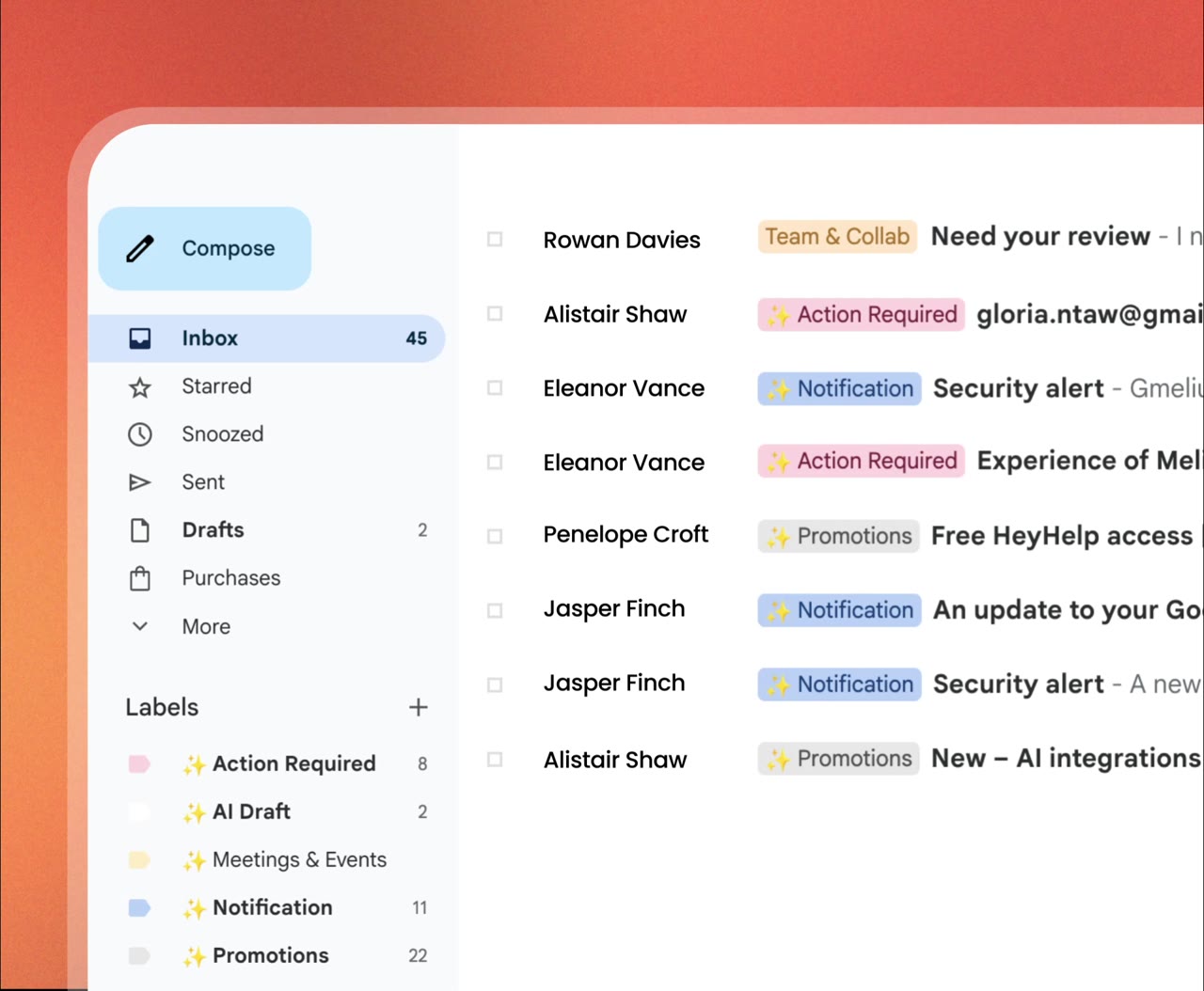
InboxPilot integrates with existing Gmail or Outlook interfaces, allowing teams to maintain familiar workflows while adding automation capabilities. The setup process takes under two minutes, and users continue working within their preferred email client.
This approach minimizes disruption and learning curves, enabling teams to adopt automation without requiring interface changes, workflow migration, or extensive training.
Shortwave's Client Replacement Model
Shortwave requires switching to a completely new email client interface. This transition involves:
- Learning a new interface and navigation patterns
- Migrating email workflows and organizational systems
- Potential disruption to team productivity during transition
- Training requirements for all users
- Adaptation to different keyboard shortcuts and interaction patterns
While Shortwave's interface is designed for efficiency, the learning curve and transition requirements create barriers to adoption that InboxPilot avoids through its integration approach.
Data Integration and Contextual Responses
InboxPilot's Multi-Source Integration
InboxPilot aggregates context from multiple sources to generate business-specific responses:
- Website content and public documentation
- Internal documents and knowledge bases
- CRM data from HubSpot, Salesforce, Zoho, and other platforms
- Historical email conversations
- Custom training data
This comprehensive data integration enables responses that reflect actual business knowledge, answer domain-specific questions, reference company policies, and maintain brand voice consistency.
Shortwave's Context Limitations
Shortwave relies primarily on email history and AI memory for generating responses. While the platform's natural language search can analyze email history effectively, its context gathering is more limited compared to InboxPilot's multi-source approach. This limitation becomes apparent when handling inquiries requiring knowledge beyond email history or when maintaining consistency with company documentation.
Customization and Control
InboxPilot provides extensive customization options:
Tone Management: Organizations can configure tone preferences per inbox or department, enabling different communication styles for sales, support, HR, and other functions.
Response Configuration: Users control response length, creativity levels, and detail depth based on inquiry type and organizational needs.
Workflow Customization: Auto-send rules, escalation paths, and fallback logic can be tailored to match specific business processes.
Department-Specific Settings: Different inboxes can have distinct configurations optimized for their specific use cases.
Shortwave offers more limited AI customization. While Ghostwriter learns user writing style and can adapt to preferences, the platform doesn't support the same granular control over workflows, automation rules, or department-specific behavior that InboxPilot enables.
Use Case Analysis
Customer Support Teams
InboxPilot enables support teams to automate ticket responses using knowledge bases, implement smart escalation based on confidence scoring, route tickets automatically through Email Actions, and manage multiple shared inboxes. The Zendesk integration provides unified support workflows.
Shortwave's email client features don't translate directly to high-volume support scenarios. The platform's strength lies in individual email management rather than team-based support automation.
Sales Teams
InboxPilot supports sales teams with personalized follow-ups using CRM data, instant contextual responses for speed-to-lead, objection handling from documentation, and tone control that adapts to different sales stages. HubSpot and Salesforce integrations provide seamless CRM connectivity.
Shortwave's AI search capabilities can help sales teams find information quickly, but the platform lacks the same depth of CRM integration and sales-specific automation that InboxPilot provides.
Growing Businesses
InboxPilot's usage-based pricing scales more efficiently as businesses grow, with costs tied to email volume rather than headcount. Unlimited seats without per-seat fees make it practical for organizations with varying team sizes. The integration approach eliminates the need for email client migration.
Shortwave's per-seat model creates predictable but potentially expensive scaling, with costs increasing linearly with team size regardless of actual email volume. The client replacement requirement adds migration complexity that may not be practical for all organizations.
Where Shortwave Excels
Shortwave offers advantages in specific areas:
AI-Powered Search: Natural language search capabilities that analyze email history to find information quickly using descriptive queries rather than keywords.
Ghostwriter Personalization: The drafting feature learns user writing style over time, creating increasingly personalized drafts.
Multilingual Support: Instant translation features for reading and writing emails in multiple languages.
Scheduling Assistance: AI-generated scheduling emails that help manage calendar coordination and appointments.
For businesses where email automation and workflow management are primary requirements, InboxPilot's advantages in pricing, automation capabilities, and integration approach typically outweigh Shortwave's client-focused features. Additionally, organizations avoid the disruption and learning curve associated with switching email clients.
Decision Considerations
Organizations evaluating these platforms should consider:
Primary Objective: If email automation and workflow management are the main goals, InboxPilot's Email Actions and auto-send capabilities provide more comprehensive automation. If enhancing the email client experience is equally important, Shortwave's interface features may be valuable.
Migration Tolerance: InboxPilot integrates with existing email clients, minimizing disruption. Shortwave requires switching to a new client, which may not be practical for all organizations.
Team Size: InboxPilot's usage-based pricing scales more cost-effectively as teams grow, while Shortwave's per-seat model becomes increasingly expensive with headcount.
Budget Constraints: InboxPilot's free tier and lower entry-level pricing make it more accessible for organizations with limited budgets or those wanting to test automation before committing.
Automation Requirements: Organizations needing true email automation with auto-send capabilities and workflow management will find InboxPilot's features more comprehensive.
Conclusion
Shortwave provides an AI-powered email client experience with natural language search and personalized drafting, making it suitable for individuals and teams prioritizing email client efficiency and willing to invest in per-seat subscriptions and client migration.
InboxPilot focuses on email automation and workflow management, providing superior value for businesses implementing automation at scale. The platform's usage-based pricing, unlimited Email Actions, comprehensive customization options, and integration approach make it better suited for organizations requiring email automation across teams and departments without the disruption of switching email clients.
The choice depends on specific organizational needs, but for most businesses seeking comprehensive email automation, InboxPilot's combination of better pricing, advanced automation capabilities, and integration approach makes it the more practical solution.
Organizations can evaluate InboxPilot through the free plan, which includes 15 emails per month and unlimited Email Actions, providing a risk-free way to assess the platform's fit for their automation requirements.